Two of the oldest matchmakers in the market are eharmony and Match.com. While both providers started out quite similar (back in the late 90s and early 200s), they’ve each taken a different path over the next two and a half decades.
In today’s article, we want to compare eharmony vs. match with the goal of providing you the information you need to decide if one of these matchmakers is the right fit for you or not.

Comparing eharmony and Match
| eharmony | Match | |
|---|---|---|
| Overall Winner? | ✅ | ❌ |
| Availability | Nationwide | Nationwide |
| Member Size | Not public | Not public |
| Founded | 2000 | 1995 |
| Starting Price | $19.99 per month | $20.99 per month |
| Relationship Goal | Serious | Serious and casual |
| Trust Pilot Score | 2.7 | 1.2 |
| App Store Rating | 4.0 | 3.9 |
| Google Store Rating | 3.0 | 3.1 |
| Google Play Downloads | 5 million+ | 10 million+ |
| Matching Style | Curated matchmaker | Catalog search |
| Try Free | Visit eharmony | Visit Match |
Our overall opinion is that eharmony is the better choice.
While the data in our eharmony vs. match comparison table is extremely helpful, the big question you may be wondering is how does that impact which dating service is best for you? To answer that question, we’d like to share our opinion on who the winner is of the eharmony vs. Match.com debate.
In our opinion, eharmony is the better option than Match.com primarily due to Match.com’s legal troubles with the FTC and eharmony’s track record of successful matchmaking.
If you’d like to check out eharmony with a free trial account, you may use the button below to get signed up now. You don’t need any coupon codes; the link automatically gives you access to the highest level free trial account currently available.
As we believe it’s important to back up all of our claims with evidence and reasoning, we’ll share how we got there in the coming sections.
Match.com’s past legal troubles are a concerning difference from eharmony.
Ensuring a safe matchmaking experience is always an important part of the comparison process. When it comes to Match.com and eharmony, there’s are two legal issues — one is glaring and the other feels like a non issue. Here’s what you need to know.
Match.com was sued by the FTC in 2019 for “using fake love interest ads to trick customers into paying”.

Arguably one of the most explosive matchmaking news stories of the last 10 years was Match.com being sued by the Federal Trade Commission (FTC) for tricking users into paying for subscriptions by using fraudulent interests.
Here’s what the FTC complaint said was happening:

“Between 2013 and at least mid-2018, consumers who were considering purchasing a Match.com subscription were generally not aware that as many as 25-30 percent of Match.com members who registered each day were using Match.com to perpetrate scams. These scams include romance scams, stealing consumers’ personal information through “phishing,” promoting dubious or unlawful products or services, and extortion scams, in which a scammer will induce a consumer to send the scammer compromising videos or pictures of the consumer that the scammer then uses to extort money from the consumer by threatening to send the materials to the consumer’s friends or family.”
Case 3:19-cv-02281-K Document 1 – Page 5
Later in the document, it goes on to say this:
“For example, in some months between 2013 and 2016, more than half of instant message initiations and favorites that consumers received originated from accounts that Defendant identified as “fraudulent,” meaning that Defendant determined the Match.com user was likely to be perpetrating some form of scam.”
Case 3:19-cv-02281-K Document 1 – Page 6
And lastly, and arguably most importantly, it says this:
“Defendant used these fraudulent communications to induce consumers to subscribe to Match.com. When consumers received these communications, they also received accompanying advertisements from Defendant encouraging them to subscribe to Match.com in order to view the content of the communication and the identity of the sender.”
Case 3:19-cv-02281-K Document 1 – Page 6
In other words, Match had a lot of fake spammer accounts. These accounts were sending messages to real users. Real users saw the notifications but couldn’t read the messages (because you need a premium membership to do so). And then Match would send them an ad asking if they wanted to upgrade to read the messages…that Match knew was from scammers.
Yes, this was back in 2019 and most likely Match has cleaned up their act since (assumption). For us, though, it’s too recent and too egregious for us to ignore. It’s also plenty for us to easily declare eharmony the winner of the eharmony vs. Match debate — by miles.
eharmony has been sued before, but for a much lesser infraction.
In 2018, several counties in the state of California sued eharmony claiming that they needed to do a better job of sharing their auto-renewal procedures. The case was settled out of court and the following changes were required of eharmony, including penalties and restitution of $2.28 million/
As part of the automatic renewal lawsuit settlement agreement, eHarmony agreed to: (1) pay up to $1 million in restitution to California State customers whose subscriptions renewed automatically and were denied refunds when requested; and (2) pay the State $1.28 million in penalties. In addition, the settlement terms require:
People of the State of California v. eHarmony Inc., Case No. 17-cv-03314, in the Superior Court for the State of California, County of Santa Cruz
- eHarmony to clearly and conspicuously disclose automatic renewal terms;
- eHarmony to obtain express consent from consumers through a check-box, signature, or other similar mechanism that consumers must affirmatively select to accept the automatic renewal offer terms;
- that the automatic renewal terms be in visual proximity to the express consent mechanism;
- eHarmony to send consumers an email summary of the automatic renewal terms after registration;
- eHarmony to allow consumers to cancel their orders in a simple manner, such as via email; and
- eHarmony to clearly and conspicuously on the face of its contract, and in close proximity to customers’ signatures, include its cancellation terms.
In our personal opinion, this is nothing more than California being aggressive when it comes to consumer practices and subscriptions. Regardless, even if you do deem it as a problem, it’s nowhere in the same solar system as purposely defrauding customers like Match.com.
A University of Florida and Gonzaga data study says eharmony works better.
In 2013, researchers from the University of Florida and the University of Gonzaga conduced a study to see which of these two matchmakers was responsible for the most marriages. Here’s a look at the raw data:
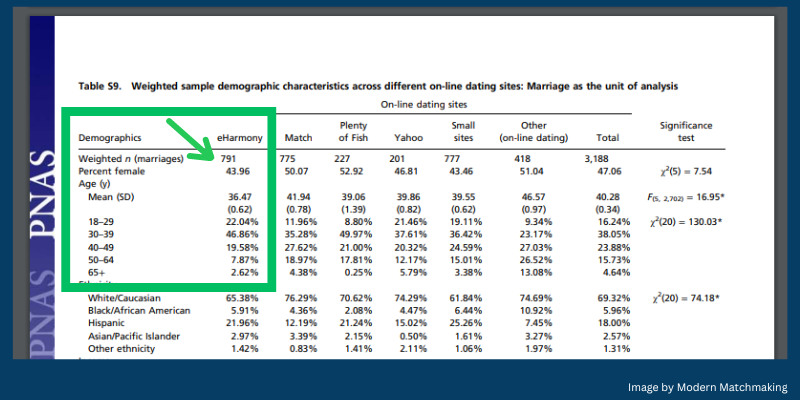
As you can see, eharmony beat out Match.com as the dating company responsible for the most marriages. The data also goes on to show that eharmony had the lowest percentage of marital breakups and the highest rate of marital satisfaction when compared with Match.com.
The data is a bit old, so it needs to be treated as such, but it’s one of the most compelling pieces of evidence as to which option may deliver the best results. If you’d like to learn more about the study, make sure to check out our full eharmony review.
eharmony’s all-in pricing compared with Match’s a la carte + subscription plans.
The monthly subscription costs for eharmony and Match.com are quite similar, both starting around $20 to $40, depending on the membership time and term length you select.
The major difference, though, is that eharmony uses an all-in pricing model where you pay once and get access to all of the available features. Match.com gives you access to most of their features with your subscription payment, but several features are only available through an additional a la carte purchase.
While we prefer the all-in pricing model, this is probably only a slight win for eharmony or a draw. The reason for this is that most of the features included with the initial Match subscription purchase mirror what you get with eharmony. This means that most of the add-on a la carte options are additional features that aren’t on eharmony.
The one exception to this is read receipts that tell you if and when your match has read your message. This feature comes bundled on eharmony without an additional payment but requires an additional $2.99 per month on Match. The other features, though, include a private number to talk and text from, the ability to pay for hand-picked matches (by a person), and paying so that any member (even free members) can respond to your messages.
The evidence shows one matchmaker is only for serious relationships and the other is for serious and casual.
Lastly, we want to share where each app places its stance on relationship goals. With eharmony, it is 100% designed for serious relationships. Every bit of marketing and the matchmaking process are designed to help you find a committed relationship. If you’re looking for casual dating, you will not enjoy your time on eharmony. This does serve as a perk for those looking for serious relationships.
Match.com, on the other hand, allows users to select several different dating intents including ‘Just see who’s out there’ and ‘Date, but nothing serious.’

Technically, the win on this depends on what you’re looking for. However, as matchmaking is focused on serious relationships and because we think when providers focus on one relationship goal it’s a much better experience — we give this win to eharmony.
Our clear pick in the eharmony vs. Match debate is eharmony.
Our verdict is that eharmony is the clear winner between the two matchmakers. The legal troubles of Match.com are too much for us to overlook and eharmony’s robust features, impressive track record, and focus on serious relationships are all reasons for this.
If you’d like to check out eharmony for free, use the link below to automatically claim your eharmony free trial now.