Hiring a professional matchmaker can be an exciting time for singles. But just because you’re excited doesn’t mean you can throw caution to the wind and start making purchase decisions without thinking. The cost of hiring a professional matchmaker is significant, which means you’ll want to make sure you’re getting exactly what you think you are.
More importantly, you’ll want to make sure everything you think you’re getting is properly detailed in your matchmaking contract.
Today, we’re going to look at 31 questions you need to ask before signing a matchmaking contract. If your matchmaker isn’t able to answer these questions to your liking, it may be a red flag, and you may want to walk away from the deal.
Let’s look at the questions broken up into applicable categories.

Questions on Expectations
When you’re making a substantial purchase like hiring a professional matchmaker, you need to be quite clear on what you’re expecting of your matchmaker, as well as what they are expecting of you. Failure to align on these things is a recipe for a bad experience. Here are the questions you should ask surrounding expectations.
Note: None of these questions are meant to make you think all matchmakers are out to dupe you (they’re not). They’re merely designed to help you get the most out of the experience and to prepare you for the off-chance that something doesn’t go according to plan.
Can you show me in the contract where it outlines what you’re required to do?
Matchmakers can promise you the world, but the reality is that it’s hard to hold their feet to the fire for failure to deliver unless it’s spelled out in your contract. Have them show you in writing the tangible deliverables that you can expect to see.
Some examples of follow-up questions could include:
- How many total matches am I going to get?
- When will I receive my first match?
- What is the cadence for getting my additional matches?
- How much contact/access will I have to you (the matchmaker) during the process?
- What about the additional amenities that I’ve been promised?
- Are my deal breakers treated as suggestions or non-negotiables? (We will explore this in detail later on in the article).
While, in many cases, they’re legally required to deliver on what they verbally promise to you during the sign up process, having these things spelled out in your contract protects you from misunderstandings or in the case that your matchmaker isn’t above-board.
What are your expectations of me?
If you haven’t read our article on what it’s like to work with a professional matchmaker, we highly recommend you do so now. In this article, we outline that while a matchmaker will do most of the work for you, there are still things that will be expected of you.
If you fail to deliver what is expected of you, it may lower the quality of your experience and it also most likely means your matchmaker is no longer contractually required to deliver on their promises.
Again, this is not meant to scare you; it’s just meant to be realistic. Here are a few of the things that you should ask to see if they’re expected of you:
- Will I be completing an onboarding questionnaire?
- How will I share information with you about what I do and don’t like in a match?
- How am I expected to share feedback with you after a date?
- What happens if I don’t show up to a date you plan?
- Do I plan the actual date activities or do you?
Who will I be working with and how much contact will I have with them?
Sometimes, the person you initially speak with when setting up your matchmaking contract isn’t going to be your actual matchmaker. They might be a sales agent who then passes you off to your matchmaker. Because of this, it’s important that you ask questions to know exactly who you will work with and how good at their job they are.
This may or may not be spelled out in your contract, but it’s something that at the very least you’ll want to know. Here are a few additional questions to ask here:
- Who are they?
- How long have they worked for you?
- What is their experience?
- Can you share information about their success stories?
- Have they ever had any customer complaints?
What is your process if you can’t find me a match?
Matchmaking services can work wonders, but they are not magicians. Sometimes, they may struggle to find you a match that meets your wants and needs in the contractually allotted timeframe. The question you need to ask is what happens in this situation.
The ‘right’ answer here is up for debate, but in our opinion, the correct thing for a matchmaker to do is communicate this to you and let you know that they are working hard on finding someone for you. Additionally, we’d also like to hear that they’re pulling in additional resources (another matchmaker) to help find the right person.
The wrong answer is forcing a match on you that doesn’t fit your needs. We’ll cover some examples of this in our next section.
This is one area that we’d highly recommend ensuring it is covered in your contract, purely from a “we’re all on the same page” standpoint. Remember, contracts aren’t always solely about protecting yourself; sometimes parts of them are about clarity for both sides.
Are my deal breakers treated as suggestions or non-negotiables?
When you onboard with a matchmaker, they’ll ask you what you’re looking for in a match. Often, matchmakers will ask you to classify these traits into wants (things you’d like) vs. needs (things you can’t live without). Additionally, they may further ask which of these are deal breakers for you (things that are a hard line, non-negotiable).
This is all fantastic and something you’ll see from a high-quality matchmaking service.
The question you should ask, though, is how are your deal breakers going to be treated? Are they treated as suggestions and they’ll “do their best” to meet them, but they might give you a match who doesn’t? Or are they treated as true non-negotiables where you won’t see a match that doesn’t meet those traits?
Matchmakers have been sued in the past for failing to uphold people’s deal breaker requests. It is imperative that in your contract it reads that the matchmaker will not send you matches that don’t match your deal breakers.
Additionally, it would probably be wise to include those deal breakers within the contract or at least as an addendum/exhibit attached to the contract. This may seem excessive, but we assure you that it’s not.
Questions on Refunds, Renewals, and Pausing
Beyond expectations, it’s important to make sure your matchmaking contract covers the nitty-gritty details that could arise during your experience. Keep in mind that many of the answers to these questions may not seem like they’re in your favor (and that’s okay), but you should at least be aware of them.
Again, this is not cause for alarm, it’s just things to be aware of for clarity sake.
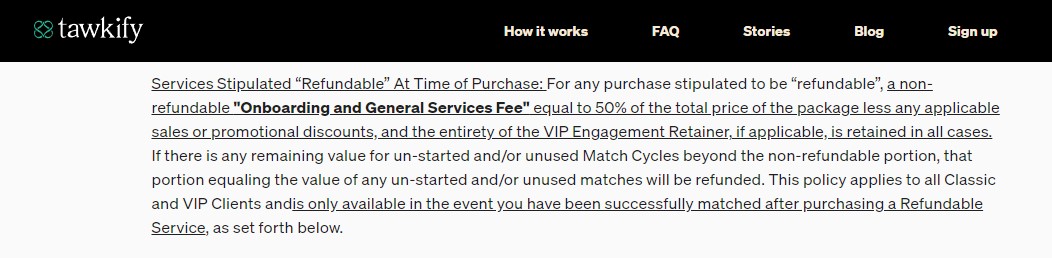
What is your refund policy?
Most matchmaking services do not offer refunds unless they’re unable to deliver on their service promises. That said, ask about it anyways. If things go south, you’ll want to know in writing what your options are.
Here’s a screenshot of Tawkify’s refund policy in their Terms of Service (TOS). Be aware that some TOS’ have a clause that they can be changed at anytime, so it may be different than having something in a contract.
Is there an auto-renewal clause in the contract?
Matchmaking services tend to be split when it comes to auto-renewal of contracts. You’ll see some who do it, and you’ll see some who don’t. Find out with 100% certainty where the matchmaker you’re hiring stands on this, and make sure it’s covered in the contract.
Can I pause my membership?
Most matchmakers don’t allow you to pause your membership if you hit it off with someone. One exception that we know of is Three Day Rule that allows you to pause for an extended period of time and even convert unused credits if that relationship works out. This is not the norm, though, so be aware of that.
Larger matchmaking companies will be set in their ways on this, but with smaller, local companies, you may be able to ask for something like this to be added into a contract.
Questions on Confidentiality
The last area you’ll want to ask questions about before signing a matchmaking service contract is confidentiality. Here are a few questions to ask:
How much information do you give my dates about me?
It’s understandable that they’ll share some information with someone you’re going to go out with, but you need to know the exact level of that. While many matchmakers do conduct background checks, you still want to be protected in case things don’t go well.
Here are a few specific questions to ask:
- Do you share my last name with a match?
- Do you share my profession or where I work or my financial status?
- Do you share any information about where I live?
- Do you share any information about my family situation (kids, divorce, etc.)?
- Do you share anything about what I’m looking for?
How much information do you retain after I’m a client?
It’s important to know what happens with your information after you part ways with a matchmaking service, whether that departure is because you met someone or because it didn’t work out. Most reputable matchmakers do well with this, but it’s at least worth confirming, especially if you’re using a smaller, more boutique matchmaking service.
Unacceptable Responses from a Matchmaker
To close, we want to prepare you in case your matchmaker tries to give you an unacceptable answer to one of your questions. Again, and at the risk of sounding like a broken record, this is not meant to scare you or lead you to believe this is going to happen. We just believe in transparency and preparing for all situations when possible.
Here are a few things you may hear from a matchmaker that we feel are unacceptable responses to these questions.
We use a standard contract and can’t make edits to it.
This may be the case with some of the larger matchmaking companies, but even then, special accommodations can be made for purchases of this size.
If a matchmaking company won’t put something in a contract that you are not comfortable signing without, don’t sign the contract. It’s okay to walk away and choose another option.
That’s just industry standard.
In a lot of cases, this may be true. However, “this is how we always do it” tends to also be a lazy excuse companies in all industries use to prey on unknowing customers. Again, if you’re not okay with it, don’t sign the contract. Even if it truly is the industry standard, you shouldn’t sign up for something you aren’t fully comfortable with.
And in case you’re looking to know what the industry standard is, spend some time reading through our articles to get a feel for what is and is not expected.
Oh, don’t worry about that. I’ll take care of you.
If your matchmaker isn’t willing to take the time to add something to your contract to make you feel comfortable, you may want to question if they’re going to go above and beyond for you when you are a client.
Promises are great and in a lot of situations can be binding, but without a contract to back that up, it’s a ‘he said, she said’ type situation. If there is something you want from your matchmaker and you want it guaranteed, get them to put it in the contract. You can tell them, “Hey I totally trust you, but I always get things in writing just for clarity-sake to avoid misunderstandings. It protects both of us.”
One more time from the broken record…
Working with a professional matchmaker can be an incredibly rewarding experience. In fact, many people rave about their experiences, even if they don’t meet the right one. So, don’t let these questions sour the excitement for you.
Think of it like buying a new car. You can be excited, but when it’s contract time, you have to put on your serious pants to ensure you get what you want. Once the contract is done, you go right back to being excited about the process.